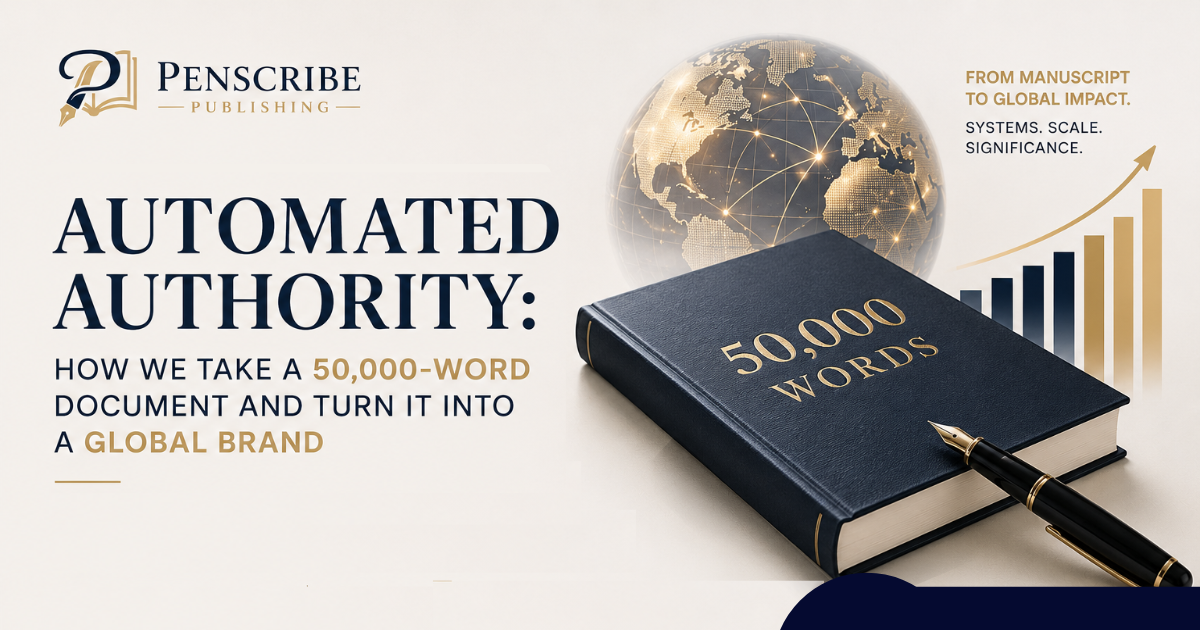
AUTOMATED AUTHORITY: How we take a 50,000 Word Document and turn it into a Global Brand:
A data-driven case for why your manuscript is your most underutilized business asset and a step-by-step SOP for activating it.
There is a file sitting on someone's hard drive right now.
It is 50,000 words. It took 18 months to write. It contains a decade of professional insight, proprietary frameworks, hard-won methodologies, and thinking that no competitor has publicly articulated. The person who owns it is smart. They are credentialed. They are good at what they do.
And that file is costing them money every single day it sits there unopened.
Not because the content is bad. Because it has not been operationalized.
A manuscript is not a business asset. It is a business liability a cost center that consumed time, energy, and cognitive resources without yet producing a single inbound lead, a single speaking inquiry, or a single consulting engagement at a premium rate. The transformation from liability to asset is not a creative exercise. It is an engineering problem. And in 2026, the tooling exists to solve it at a scale that was structurally impossible five years ago.
This post is the SOP.
The Market Context: Why 2026 Is the Inflection Point
The global eBook market, valued at $50.61 billion in 2025, is expanding at a CAGR of 16.99%, rivaling physical print for the attention of professionals and academics alike. Simultaneously, the Immersive Content Creation market—incorporating AR, interactive elements, and 3D environments—is set to explode from $27.3 billion to $206.3 billion by 2034.
[Image: Global Market Growth Comparison (eBooks vs. Immersive Content 2025-2034)]
The Collapse of the Audio Barrier
The cost of entry for professional-grade audio has effectively evaporated.
Growth: AI-narrated audiobooks saw a 36% YoY growth (2023–2025) and now account for nearly one-quarter of all new releases.
Efficiency: Production that once required thousands of dollars and months in a studio now takes hours and costs a fraction of legacy budgets.
The Multi-Modal Mandate
With 54% of publishers already adopting AI for content enhancement and workflow automation, the definition of a "book" has evolved:
Static to Interactive: High-value creators are replacing flat text with Enhanced eBooks featuring audio narration, augmented visuals, and gamified annotations.
Global Ecosystems: Success in 2026 belongs to those who view their manuscript as a "content ecosystem" deployed simultaneously across global digital platforms.
Strategic Conclusion: In the 2026 economy, if you are still calling it a "book," you are already behind. The modern author-entrepreneur builds an asset; the hobbyist writes a document.
The Distribution Argument: 160+ Countries vs. One Local Bookshelf
In 2005, publishing was a 24-month cycle of negotiation, physical inventory risk, and 10–15% royalties, entirely dependent on a publisher's limited retail relationships. By 2026, the "geographic ceiling" has collapsed.
Global Retail Activation: Through platforms like IngramSpark, a single optimized upload now activates a presence across 40,000+ retailers, libraries, and bookstores globally.
The 72-Hour Global Launch: While Amazon retains a 70–80% digital market share, modern authors use it as the floor, not the ceiling. Using aggregators like Draft2Digital or PublishDrive, a manuscript can reach 160+ countries within 72 hours—bypassing the need for physical warehouses or bookstore meetings.
Strategic Independence
The friction of managing separate international accounts has been replaced by unified dashboards. In the 2026 economy, "publishing" is no longer about winning over a middleman; it is about architecting a distribution stack that ensures your 50,000-word asset is available to every digital buyer in North America, Europe, Asia-Pacific, and beyond, simultaneously.
[Image: Timeline Comparison – 2005 Physical Constraints vs. 2026 Borderless Distributio
The Halo Effect: What a Published Book Actually Does to Your Rate Card
This section shifts the perspective of authorship from a creative achievement to a high-performance financial instrument. In the 2026 economy, the "book" is not the product—it is a credentialing mechanism that triggers a measurable Rate Structure Realignment.
The Author Premium: Quantifying Authority
Data confirms that publishing a book acts as a documented multiplier on existing revenue infrastructure for knowledge-based professionals:
Billing Power: Authors command up to 30% higher consulting fees. For a consultant billing $500/hr, this shifts the rate to $650/hr based solely on perceived authority.
Closing Ratios: Published authors secure engagements 52–67% of the time, nearly double the success rate of non-authors.
The Trust Differential: Content backed by a book is trusted 8x more than standard blog posts, serving as a critical conversion-rate variable.
[Image: The Author Premium Multiplier – Consulting Rates & Closing Percentages]
The Lead Generation Engine
For consultants and executives, the book serves as the ultimate "Verified" status in a crowded market:
Speaking ROI: Authors who speak earn 4x more than those who do not, with speaking engagements accounting for 60% of all new business.
Digital Performance: LinkedIn headlines featuring "Published Author" perform 62% better, driving higher-quality inbound leads.
Strategic Conclusion: The "Author Premium" is not a soft brand metric; it is a structural repricing of your entire portfolio. You aren't writing to sell books; you are writing to sell yourself at a 200% higher volume and a 30% higher premium.
The Converse Argument: What the Manuscript Is Costing You Right Now
The final strategic shift in the 2026 publishing landscape is the recognition that an unpublished manuscript is not a neutral draft—it is a compounding liability. While the sunk costs of writing and research are already spent, the true expense is the "Opportunity Cost of Inaction."
The Inaction Calculation: Asset vs. Liability
Every month a manuscript remains dormant, the author pays an invisible tax in lost market positioning:
Zero Inbound Discovery: You miss the consulting leads and speaking inquiries that automated Amazon and global distribution would have generated.
The Missing Premium: You forfeit the 30% fee increase and the "Author" designation that re-prices your professional brand.
Operational Stagnation: A manuscript requires mental energy without providing output; a published ecosystem runs 24/7 without your involvement.
[Image: The Cost of Inaction – Compounding Lost Revenue vs. Published Asset Growth]
Strategic Activation: "While You Sleep"
Activating the asset transforms a stagnant file into a global employee that:
Distributes 24/7: Enters 160+ markets you have never visited.
Permanent Credentialing: Locks the "Published Author" status into your professional identity forever.
Automated Authority: Generates high-value leads and establishes brand sovereignty globally while you focus on your core business.
The Conclusion: The cost of waiting is not zero; it is the total sum of the "Author Premium" you are currently choosing not to collect. In 2026, the only thing more expensive than publishing is staying unpublished.
The SOP: Manuscript to Global Brand in 7 Stages
(See the visual flow above)
The 7-Stage Revenue Activation Workflow is the operational blueprint for transforming a raw manuscript into a high-yield IP asset. In 2026, this structured sequence replaces traditional publishing's linear path with a parallel, multi-format deployment strategy.
Stages 1–3: Architecture & Production
Stage 01 | Raw Asset Audit: Treat the text as IP inventory. Identify proprietary frameworks and map the "monetization architecture" (products/services) the content will support.
Stage 02 | Manuscript Architecture: Restructure the document for multi-format value. Map chapters for audio pacing and isolate frameworks as standalone interactive modules.
Stage 03 | Core Format Production: Produce eBook, AI-narrated audio, and Print-on-Demand (POD) in parallel. In 2026, releasing only one format is considered a failure to capture available market surface area.
[Image: The 3-Pillar Production Model – eBook, Audio, and POD simultaneous workflow]
Stages 4–5: Global Distribution & Authority
Stage 04 | Global Distribution Activation: Deploy simultaneously across the full stack (KDP, Apple, IngramSpark). Optimize metadata and territorial rights at the point of upload for 160+ markets.
Stage 05 | Authority Ecosystem Activation: Use the book as a credentialing anchor. Rebuild LinkedIn, speaker kits, and consulting rate cards around the "Published Author" designation to drive inbound inquiries.
Stages 6–7: The Compound Interest Engine
Stage 06 | Content Repurposing Engine: Extract a 12-month content calendar from the 50,000-word file. The book populates newsletters, keynotes, and social feeds indefinitely, maximizing reach through modularity.
Stage 07 | Revenue Asset Management: Transition to near-zero operational overhead. The infrastructure now generates passive royalties, consulting leads, and licensing opportunities while the author focuses on high-value delivery.
[Image: The Content Repurposing Funnel – One Manuscript into 12 Months of Multi-Channel Output]
The Numbers That Frame the Decision
The digital publishing market is valued at $257 billion in 2025 and is predicted to grow to $447 billion by 2030 at a CAGR of 11.8%. StartUs Insights
Subscription-based models are expanding, with 41% adoption in e-learning platforms and 36% growth in interactive content formats. Business Research Insights
30% of a professional speaker's annual income is typically derived from follow-up consulting contracts. WifiTalents
The majority of ROI from publishing often comes from indirect sources speaking fees, consulting engagements, workshops, and increased sales for an author's organization not from direct book sales. Archynewsy
The book is not the revenue. The book is the infrastructure that the revenue travels through.
The Final Argument: Shakespeare Doesn't Want to Sell Books
When a 50,000-word manuscript is properly operationalized, it transforms from a static document into a global business engine with documented financial tailwinds:
Market Velocity: Access to a $207 billion expanding global market.
The Author Premium: A 30% consulting rate increase and a 200% uplift in speaking invitations.
Global Reach: Immediate activation across 40,000+ retailers and 160+ countries.
[Image: The Book-as-Infrastructure Model – From Manuscript to Global Asset]
The Final Mandate
Traditional publishing was built for authors; the fractional model was built for Authority. In the modern economy, a book is the foundational infrastructure that automates your top-of-funnel growth and locks in your market position.
The question is no longer about "writing a book." The question is: Are you going to build the infrastructure that compounds your expertise while you sleep?
Automated Authority is the publishing infrastructure division for professionals who treat their intellectual property as a business asset. If you have a manuscript and want to understand what your specific brand ecosystem looks like, the conversation starts in the comments or DM.